


Smart tourism uses advanced technologies such as cloud computing, the Internet of Things, and AI monitoring. Through the Internet and mobile Internet, with the help of portable Internet terminals, it integrates real-time data from scenic area ticket gates, telecom operator data, traffic management, security prevention and control, smart fire protection, smart parking, smart monitoring, and marketing management. It provides all-element, all-scenario, and full-cycle smart services for the smart upgrading of scenic areas, builds a smart cultural and tourism system for scenic areas, improves the comprehensive management and operation capabilities of cultural and tourism enterprises, creates a high-quality tourism ecological environment, and enhances the service quality of tourists in all tourism links, including food, accommodation, transportation, sightseeing, shopping, and entertainment. It turns scenic areas into nationally leading and internationally renowned smart cultural and tourism scenic areas, ultimately promoting the sustainable development of the scenic area's environment, society, and economy.

Smart Tourism Solution
Smart tourism uses advanced technologies such as cloud computing, the Internet of Things, and AI monitoring. Through the Internet and mobile Internet, with the help of portable Internet terminals, it integrates real-time data from scenic area ticket gates, telecom operator data, traffic management, security prevention and control, smart fire protection, smart parking, smart monitoring, and marketing management. It provides all-element, all-scenario, and full-cycle smart services for the smart upgrading of scenic areas, builds a smart cultural and tourism system for scenic areas, improves the comprehensive management and operation capabilities of cultural and tourism enterprises, creates a high-quality tourism ecological environment, and enhances the service quality of tourists in all tourism links, including food, accommodation, transportation, sightseeing, shopping, and entertainment. It turns scenic areas into nationally leading and internationally renowned smart cultural and tourism scenic areas, ultimately promoting the sustainable development of the scenic area's environment, society, and economy.
Solution Overview
Solution Background
Construction Background
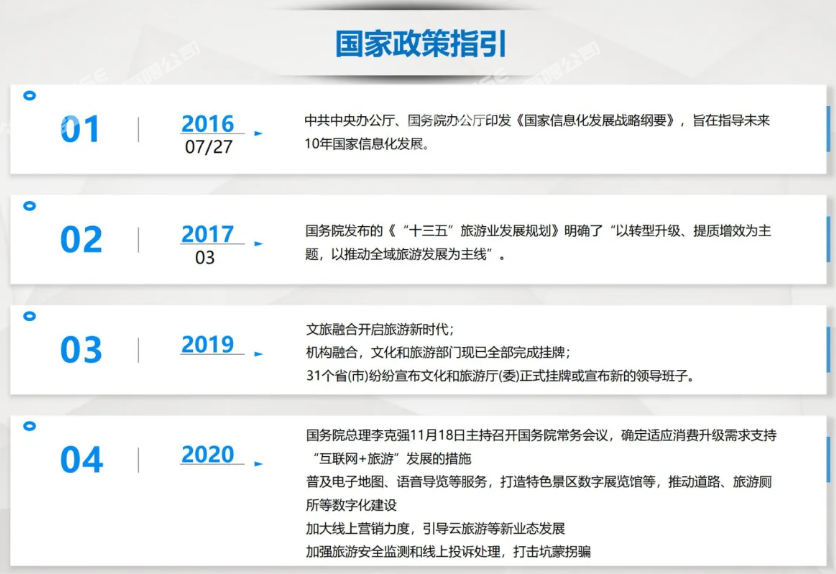
Recently, the Ministry of Industry and Information Technology, together with the Ministry of Culture and Tourism, issued the Notice on Strengthening the Coordinated Innovation and Development of 5G + Smart Tourism. The Notice sets out overall development goals and nine major tasks in three areas: 5G + smart tourism infrastructure construction, integrated innovative applications, and industrial ecosystem building. It aims to basically complete 5G network construction in China's tourism sites by 2025, significantly improve the development level of integrated 5G applications, continuously enhance industrial innovation capabilities, and achieve prosperous and large-scale development of 5G + smart tourism. Smart tourism is a very important part of the national advocacy for informatization and intelligentization in the tourism industry. We hope to complete smart tourism and ecological tourism through the joint efforts of the government, tourists, and enterprises.
Current Pain Points
In recent years, with the development and application of innovative technologies such as the Internet, big data, and digital twins in the smart field, and with the improvement of the national economic level, China's tourism service industry has continued to develop rapidly. The number of domestic tourists has increased continuously every year. While consumer demand in scenic areas has risen, it has also brought more and more scenic area management problems, such as insufficient visitor flow, many safety hazards, weak management capabilities, weak operational methods, difficult internal traffic scheduling, backward asset management methods, and difficult transformation and upgrading of scenic areas.
Marketing pain points: difficult sales system construction, insufficient scenic area promotion channels, difficult evaluation of agent capabilities, high advertising costs, high marketing costs, poor publicity results, insufficient visitor flow, etc.
Management pain points: revenue relies only on tickets, and reducing reliance on ticket revenue is difficult; it is difficult to increase other tourism consumption income in scenic areas; investors are hard to find, scenic area assets are too heavy, development is slow, the level of informatization in scenic areas is low, and management is chaotic, etc.
Service pain points: limited information technology in scenic areas, limited services provided, backward infrastructure in scenic areas, and poor tourist experience.
Necessity of Construction
Combining tourism development with digital technology helps scenic areas achieve digital exploration and construction, supports the strategic need for transformation and upgrading, helps improve the overall service quality and overall management level of scenic areas, promotes the implementation of digital scenarios in smart scenic areas, and contributes to the intelligent development of the cultural and tourism industry.
Application Value
Functional department value: unified management, efficient supervision, and data support for formulating better industrial policies;
Social value: the unique tourism IP created by smart scenic area construction forms its own brand, creates social influence, and becomes the core of all-for-one tourism. It plays a role in driving and supporting local economic development;
Industrial value: the increase in tourists brought by smart scenic area construction radiates to surrounding catering, homestay entertainment, sightseeing, hotels, and other enterprises, drives income growth for surrounding upstream and downstream merchants, and helps surrounding farmers achieve poverty alleviation;
Operational value: it complies with national classification and evaluation standards for Class A scenic areas, improves the level of scenic areas; responds to national policies, improves regional tourism service levels, and seeks national subsidy funds.
Solution Introduction
Technical Architecture
The smart tourism solution uses mobile Internet, the Internet of Things, cloud computing, big data, and GIS as key technologies. Drawing on the overall smart city framework and IoT technical architecture, it divides the overall technical framework of smart tourism into the perception layer, data support layer, platform layer, application layer, and user layer.
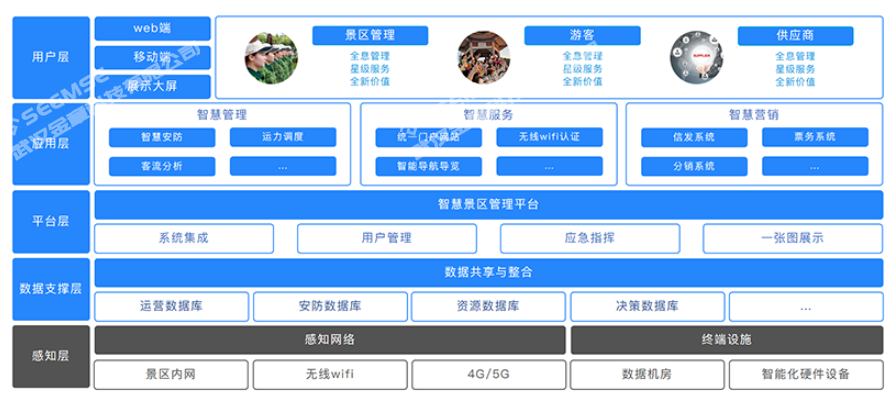
Perception layer: The perception layer collects front-end perception information data in various fields of the tourism industry through video monitoring, electronic access control, environmental monitoring, GPS monitoring, and intelligent terminal collection equipment, and realizes unified, reliable, and secure transmission of tourism information data such as sensor data, video data, alarm data, and management data among tourism enterprises, scenic areas, district and county tourism bureaus, and municipal tourism bureaus;
Data support layer: The data support layer mainly provides basic data support for upper-layer smart services. The cloud computing basic platform mainly provides hardware resources for data processing and analysis required for smart tourism construction, and the cloud data center provides a basic service platform and data support for smart tourism construction;
Platform layer: The platform layer includes a smart tourism public service platform for tourists, an enterprise service platform for enterprises, a smart tourism comprehensive management application for tourism authorities, and an emergency command platform for emergency events;
Application layer: The application layer is divided into three modules: smart management, smart service, and smart marketing. Through the all-media information release platform, it provides multi-terminal integrated tourism public information services and tourism destination marketing services for display terminals such as web terminals, smart mobile terminals, and touch screens;
User layer: The user layer mainly includes web portals, mobile apps, touch screens, and large display screens.
Solution Features
Using new technologies such as cloud computing and the Internet of Things, through the Internet/mobile Internet, and with the help of portable terminal Internet devices, it actively perceives information about tourism resources, tourism economy, tourism activities, and tourists, and releases it in a timely manner, allowing people to understand this information in time and adjust work and travel plans in time, thereby achieving intelligent perception and convenient use of various types of tourism information. The construction and development of smart tourism will ultimately be reflected in three levels: tourism management, tourism services, and tourism marketing.

Core Functions
Front-end IoT perception and information collection, and back-end business function display through platforms and servers. It includes the following management functions for people, vehicles, objects, and events.

Executive cockpit: 3D visualized dynamic simulation models, realistic scene interaction, and real-time data monitoring make it easy to grasp first-hand information about the scenic area, empower efficient operation of the smart scenic area, and easily view the distribution of all weak-current pipe networks and related equipment in the scenic area. It is the 'electronic drawing' of the scenic area's comprehensive pipeline. It collects data from intelligent terminal devices and issues early warnings, vividly and intuitively displays required data in a combination of charts and graphs, and provides leaders with 'one-stop' decision support;

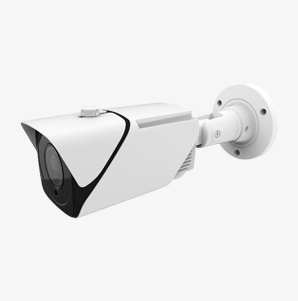
AI video monitoring system: It makes full use of the existing surveillance cameras in the scenic area. On the basis of traditional monitoring, it connects to the Qingting AI edge computing server to achieve AI risk control in the scenic area, transform traditional passive security into active early warning, build a solid security system for the scenic area, and provide strong evidence support for accident analysis and handling. If surveillance cameras are not yet widely deployed in the scenic area, Qingting AI monitoring cameras can be used directly. This is a self-developed lightweight, intelligent, and flexibly deployable smart AI camera for video streaming, detection, and recognition. It is preinstalled with a powerful AI algorithm engine. The AI chip + AI framework + AI algorithm work together to provide strong and flexible AI computing power support; it also supports solar power supply and 4G network deployment. Even without power supply or network coverage, it can achieve AI risk monitoring in the scenic area and ensure scenic area safety.
System core functions: risk monitoring, face recognition monitoring, host monitoring, AI host management, AI unit management, camera management, upgrade management, basic information management, and alarm center.

Panoramic monitoring
Operation and maintenance management system: Work orders generated by related subsystems involved in daily operations, such as tourists, scenic area maintenance personnel, vehicle and boat drivers, and negative public opinion, will be archived in the work order management module and uniformly enter the circulation and processing workflow. For temporary emergencies that require personnel from various departments to execute and handle, work orders can be manually created and enter the circulation and processing workflow. The details, processing records, and message replies from relevant personnel corresponding to all summarized work orders can be reviewed in detail in this section, realizing full-process traceability of daily scenic area management and emergencies, and tracking and statistical analysis of the work order process;
Visitor flow statistics system: By connecting with the scenic area ticket sales and inspection system, parking lot system, and video monitoring system, it obtains accurate visitor flow data in the scenic area and carries out real-time visitor flow collection and reporting, visitor flow warning and guidance, and visitor flow analysis and prediction. During peak visitor periods, it supports scenic area service, security, and other relevant departments to collaborate efficiently and methodically arrange tourist reception, reasonable diversion of over-capacity areas, and emergency handling;

Smart parking system: It uses the Internet of Things and GIS geographic information technology to realize basic information viewing, operation status analysis, parking lot location, and parking lot usage analysis for scenic area traffic conditions, optimize the resource utilization structure of the scenic area, provide scenic area managers with precise vehicle resource scheduling management, improve the scenic area traffic service experience, and enhance tourist comfort and convenience. It saves labor costs and can also analyze tourist sources;


Environmental monitoring system: It provides real-time and accurate environmental data and severe weather warning and forecasting, reducing loss of life and property caused by natural disasters. It helps improve the environmental quality of scenic areas, maintain ecological balance, improve the happiness index of scenic areas, attract tourists, and provide strong information support and scientific basis for scenic area environment, pest and disease control, crop production, ecological protection, and commerce;

Smart fire protection system: For existing fire protection systems, we have established a systematic and open solution to realize interconnection of fire water, electricity, smoke, video, RFID, fire power supply, fire hydrants, personnel, and other elements;

Emergency command system: Active monitoring, effective management, rapid coordination of various emergency response resources, accurate decision-making, and upload and delivery of instructions. Audio and video, data, wired and wireless, and other means are integrated for unified communication and command, greatly improving operational efficiency. On-site information and images are uploaded live, and decision-makers can efficiently collaborate, make remote decisions, and command based on effective resource information;

Information release system: Push scenic area safety and service-related information, improve tourists' tourism happiness index, display scenic area visitor flow information, encourage tourists to divert voluntarily, prevent crowding at key attractions, reduce safety hazards, and provide catering, accommodation, entertainment, shopping, and advertising to expand publicity and increase scenic area revenue.

Related Products


Application Cases


Latest News
 National Energy Administration Explains Progress in Charging Infrastructure Construction in the First Three Quarters
 Backed by Nearly RMB 10 Billion Investment, Power Grid Becomes the Largest Proving Ground for Embodied AI Robots
 TELD Unveils Six New Charging Products, Launching a 100MW High-Voltage Digital Ultra-Fast Charging Station
 Charging and Recharging Network Iteration: Beyond Scale Expansion, Greater Emphasis on Service Upgrading
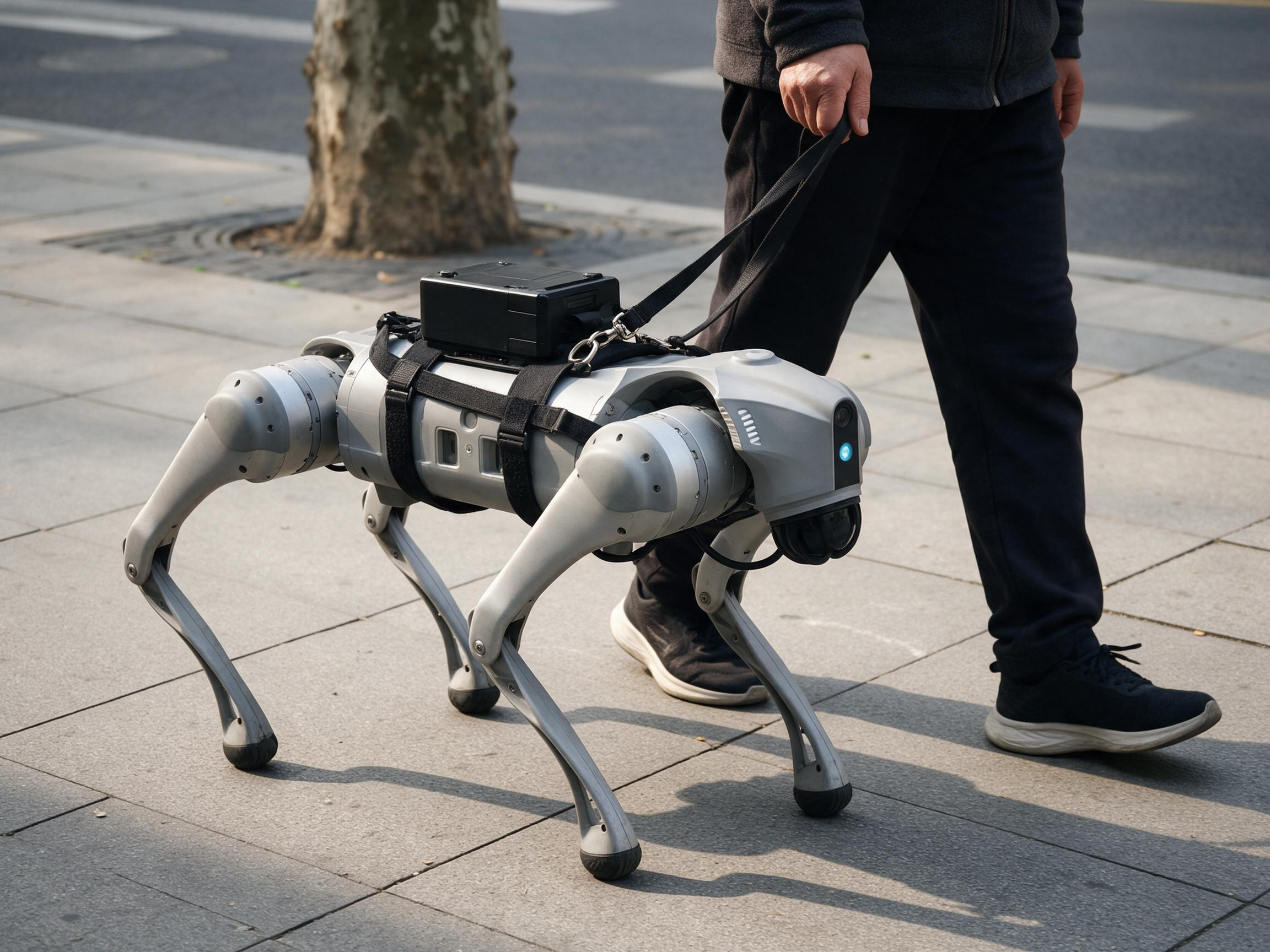 Public Call for Participating Units for the National Standard Technical Requirements and Test Methods for Guide Dog Robots