


With the in-depth advancement of Industry 4.0 and intelligent manufacturing, the intelligent transformation of factory equipment inspection has become an urgent need to improve O&M efficiency and reduce safety risks. Quadruped robots, with their ability to adapt to complex terrain and their advantage in multi-sensor fusion perception, are moving from technology demonstrations to large-scale industrial applications. This solution systematically describes the overall architecture, technical configuration, business functions, and implementation path of intelligent robotic dog inspection in factory scenarios, aiming to build a full-process unmanned inspection system of 'autonomous inspection—data collection—intelligent analysis and judgment—closed-loop handling', and to provide manufacturing enterprises with a practicable and replicable intelligent O&M solution.

Robotic Dog Factory Intelligent Inspection Solution
With quadruped robots as the core and integrating multimodal perception and edge intelligence, it enables autonomous inspection in high-risk factory areas, intelligent diagnosis of equipment status, and closed-loop data management, replacing manual work for tasks such as infrared temperature measurement, instrument reading recognition, and abnormal noise detection, helping factory inspection upgrade toward unmanned, digital, and predictive maintenance.
I . Overview
II . Project Background and Requirements Analysis
Pain Points of Traditional Factory Inspection
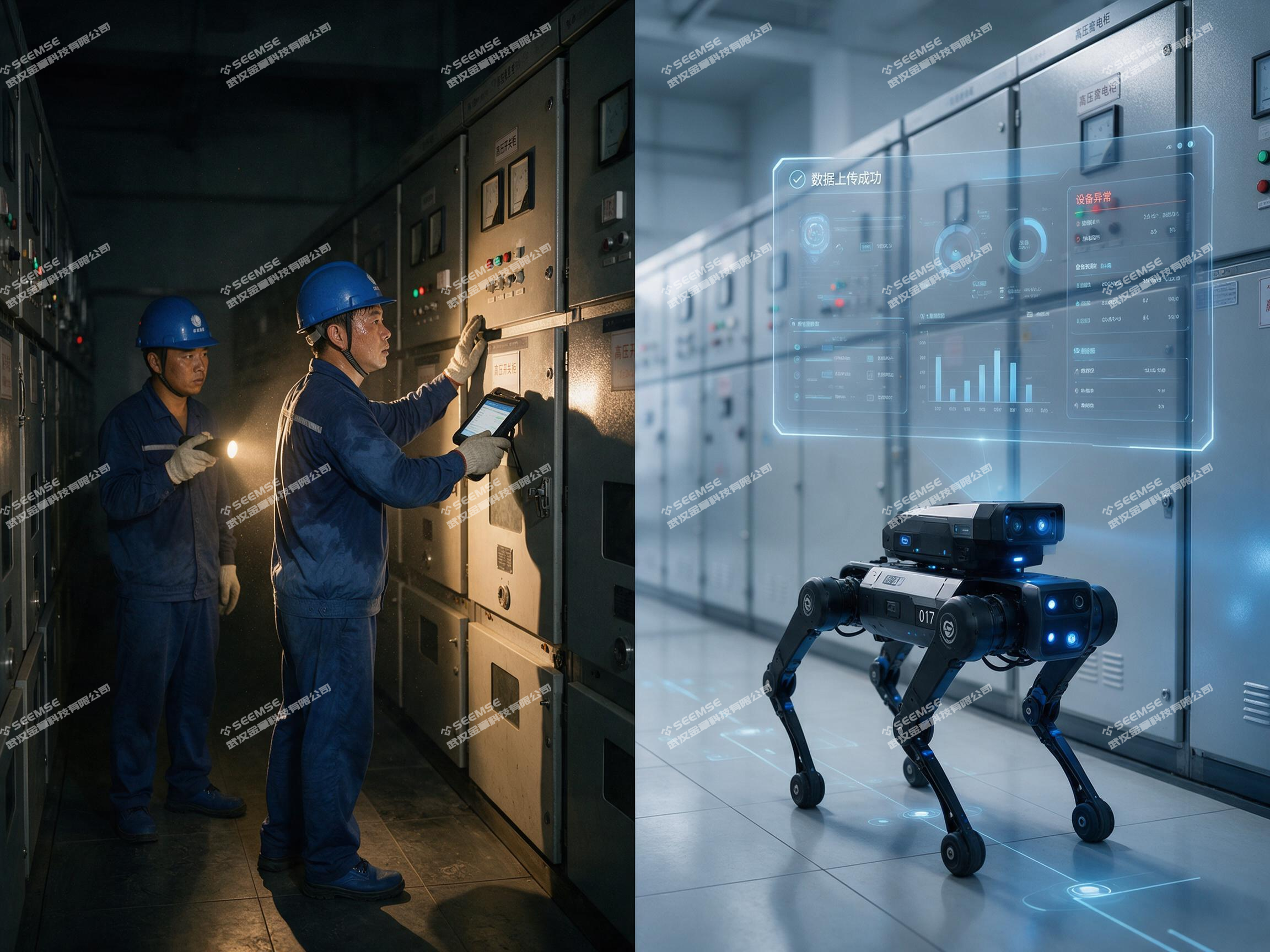
Factory equipment inspection has long relied on manual execution and faces multiple structural difficulties. In high-risk areas such as high-voltage distribution rooms, underground utility tunnels, and chemical production areas, inspection personnel must work continuously in high-temperature, noisy, toxic, and hazardous environments, resulting in persistently high safety exposure risks. Taking highway distribution room inspection as an example, the traditional mode requires two workers and three to four hours to complete one inspection round, with much of the time consumed by travel and repetitive instrument recording. More critically, the frequency of manual inspection is limited by team scheduling and is difficult to cover around the clock, with nights and holidays often becoming monitoring blind spots. At the data level, paper records or manual entry cause inspection data to be scattered and untraceable, making it difficult to identify equipment degradation trends in advance through systematic analysis.
Transformation Window for Intelligent Inspection
Industry data confirms the urgency and feasibility of this transformation. According to Counterpoint Research, in the first half of 2026, global quadruped robot shipments approached 35,000 units, of which about 40% went to industry application scenarios, with industrial inspection and security patrols together accounting for about 60% of the market share. An IDC report further shows that in the first half of 2026 the market size of industry-level quadruped robot applications grew 125.1% year on year, and deployment volume growth reached 260.5%, with government and industrial manufacturing becoming the two mainstream tracks. This means quadruped robots have crossed the concept validation stage and entered a large-scale implementation period oriented by business value.
Core Requirements of Factory Scenarios
The factory environment imposes specific requirements on inspection robots that differ from substation and park patrol: first, they must adapt to complex ground conditions in production areas, including cable trench covers, equipment base steps, narrow and long passages, and other unstructured terrain; second, they must maintain sensor data reliability in industrial environments with electromagnetic interference, dust, and temperature and humidity fluctuations; third, they must connect data with the factory's existing DCS, MES, or EAM systems instead of forming new information silos; fourth, they should have modular payload capability to meet differentiated detection needs across different plant areas and process sections.
III . Overall Solution Design
Design Philosophy
This solution takes 'autonomous mobile platform + multimodal perception + edge intelligence + platform-based management and control' as its technical mainline, positioning the robotic dog as a mobile data collection terminal and execution node of the factory intelligent O&M system. Core design principles include:
Scenario adaptation first: It does not pursue extreme motion performance, but uses the factory's actual terrain passability, endurance coverage, and protection rating as selection benchmarks. Data closed-loop driven: The value of inspection lies not in 'completing a round', but in the structured processing of collected data and the closed-loop handling of abnormal signals. Progressive deployment: First prove a single-point scenario, then expand to the entire plant area, avoiding integration risks brought by one-time large-scale investment.
System Architecture
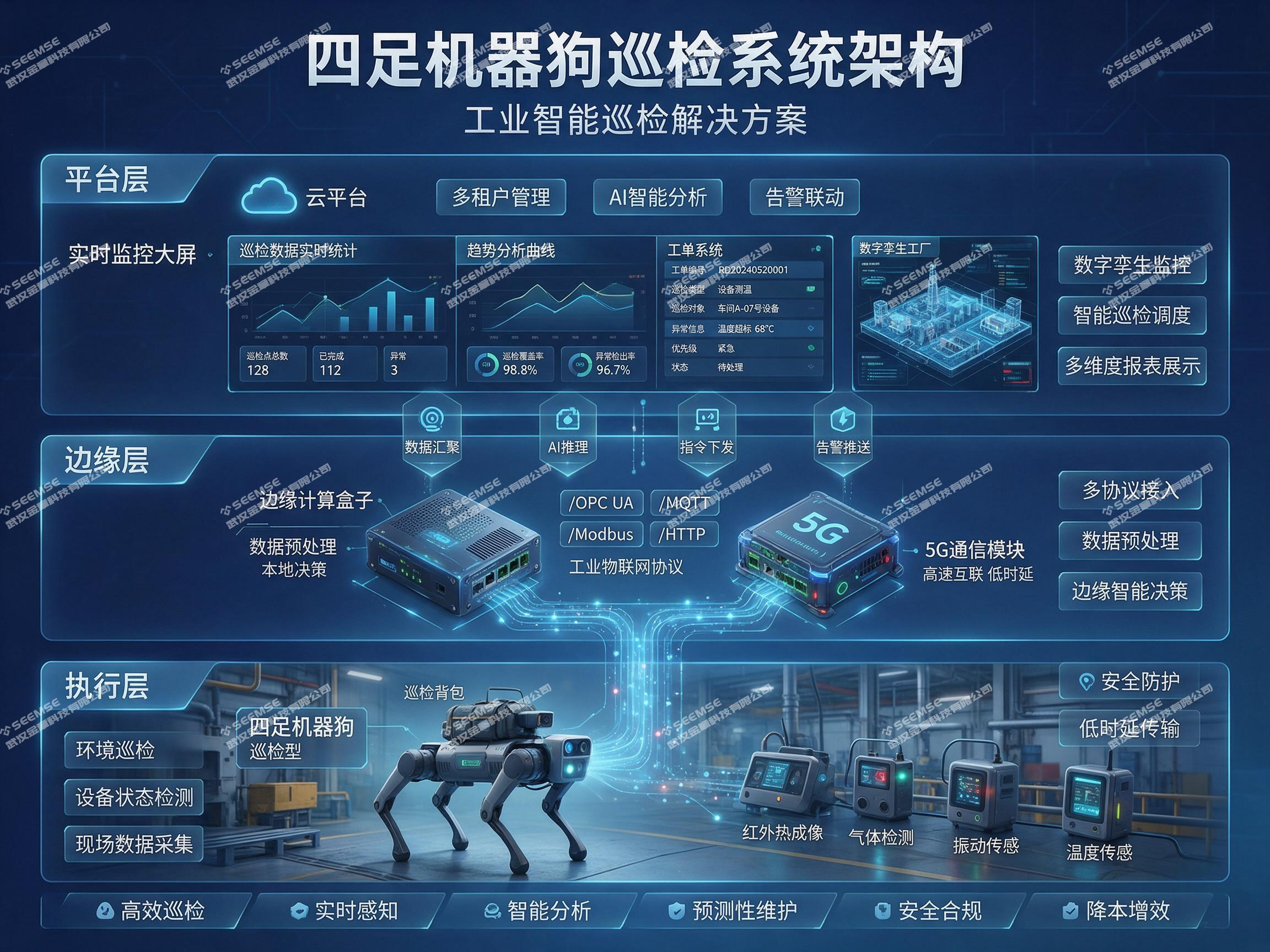
The overall architecture is divided into three layers:
Execution layer is the quadruped robot itself, equipped with a motion control system and basic sensor suite, responsible for autonomous navigation, obstacle avoidance, and data collection in the factory environment. Referring to LS ELECTRIC's deployment practice at the Busan plant, the robot itself needs IP54 or higher protection rating to adapt to oil mist, dust, and temperature and humidity changes. Edge layer is the onboard computing unit and communication module, undertaking real-time data processing and compressed backhaul tasks. For scenarios that require local anomaly recognition, the edge layer deploys lightweight AI inference models and uploads only confirmed abnormal event clips to the cloud, reducing bandwidth dependence. Platform layer is the inspection management software system, providing task scheduling, data storage, trend analysis, work order linkage, and other functions, and connecting with the factory's existing information systems.
Key Technical Configuration
Navigation and positioning adopts a fusion scheme of 3D LiDAR and IMU inertial measurement unit, with mapping accuracy controlled at centimeter level and repeated positioning accuracy better than 10 cm. For areas without GPS signals such as underground utility tunnels and tunnels, a combined navigation strategy of laser SLAM and wheel odometry is adopted. Perception payload is centered on a dual-light gimbal; the visible-light channel is used for instrument reading recognition and equipment appearance inspection, and the infrared thermal imaging channel enables non-contact temperature measurement, accurately capturing abnormal heating of motors, pump bodies, and control cabinets. Voiceprint detection collects equipment operating noise through a microphone array and uses acoustic feature analysis to identify precursors of mechanical faults such as bearing wear and pneumatic leakage. Gas sensing modules are optionally equipped with detection units for combustible gases, VOCs, or specific toxic gases for specific areas such as chemical and coating areas. Modular design allows the same robot platform to quickly replace sensor combinations or add a robotic arm for simple operations according to differences in inspection areas.
IV . Core Business Functions
Intelligent Diagnosis of Equipment Status
The core value of robotic dog inspection lies in systematizing and standardizing the perception capabilities of 'seeing, hearing, smelling, and measuring'. In equipment status diagnosis, infrared temperature measurement can cover key equipment such as vacuum pumps, motors, control cabinets, and transformers, identifying hidden dangers such as seal failure, poor contact, and abnormal heat dissipation through temperature difference analysis and comparison with historical baselines. For instrument readings, deep learning-based visual models support automatic recognition of pointer meters, digital meters, and level gauges, eliminating errors and delays in manual recording. Voiceprint analysis establishes sound fingerprints of normal operation for rotating machinery and automatically triggers warnings when spectral features deviate from the baseline.
Environment and Safety Monitoring
Hidden risks in factory environments are often more fatal than equipment failures. Robotic dogs can periodically collect temperature and humidity, smoke, and combustible gas concentration along preset paths, completing environmental safety pre-judgment before personnel enter. For high-risk points such as chemical storage areas and confined space operation entrances, fixed-point detection tasks can be set, and alarms are issued immediately when data are abnormal. In addition, the vision system can identify unsafe behaviors and conditions such as personnel not wearing PPE, entering dangerous areas in violation of rules, and blocked fire exits, realizing the integration of security and inspection functions.
Autonomous Inspection and Remote Intervention
The robot performs inspection according to preset task templates and supports three modes: scheduled tasks, periodic tasks, and temporarily issued tasks. In daily mode, the robotic dog completes inspection of the entire area or a designated area along the optimal path, and inspection reports are automatically generated and pushed to O&M personnel. When an abnormality is found, the platform automatically captures a 30-second data clip before and after the event, marks the anomaly type and location, and notifies the responsible person according to the plan level. For scenarios requiring further confirmation, O&M personnel can remotely take over the robot, control it to approach the abnormal point for detailed inspection, and obtain higher-resolution images or longer-duration sound samples.
Data Assets and Trend Analysis
The value of inspection data lies not only in 'current anomaly discovery', but also in the equipment health records formed through long-term accumulation. The temperature, vibration, sound, and image data from each inspection are archived by equipment number and timestamp, forming a traceable and analyzable structured dataset. Based on these data, the system can build degradation trend models for key equipment and provide predictive maintenance recommendations before failures occur. LS ELECTRIC's practice shows that factories are using data collected by robotic dogs to build AI analysis models to support the upgrade from preventive maintenance to predictive maintenance.
V . Implementation Path and Deployment Recommendations
Phased Advancement Strategy
A three-phase deployment path is recommended. Phase I is pilot validation, selecting 1 to 2 typical scenarios (such as a high-voltage distribution room or core pump room), deploying 1 robotic dog to complete technical validation and process running-in, with focus on confirming navigation reliability, sensor accuracy, and platform usability. Phase II is scenario expansion, replicating to similar scenarios based on the pilot and expanding to differentiated environments such as chemical production areas and warehousing and logistics areas, forming multi-robot collaboration capability. Phase III is plant-wide integration, deeply connecting the robotic dog inspection system with the factory's EAM and DCS systems to achieve a process closed loop from 'inspection discovers anomaly' to 'automatic work order generation'.
Key Deployment Considerations
Charging and endurance: Robotic dog endurance is usually 2 to 4 hours, so automatic charging station locations need to be planned in the inspection area, supporting autonomous return for charging at low battery. Communication coverage: The quality of Wi-Fi or 5G networks in the factory area needs to be evaluated; for signal blind spots, edge storage and post-event backhaul strategies can be adopted, or communication relay nodes can be deployed. Human-machine collaboration should not be understood as 'complete replacement of manual labor'; in the initial stage, it is recommended to retain a regular manual review mechanism, both as a redundancy guarantee for system reliability and to provide O&M personnel with a psychological transition period to adapt to new tools. The practice at the Yeosu plant shows that when experienced workers see the robotic dog automatically complete an inspection round and generate a clear report, their acceptance of the technology increases significantly.
Organizational and Institutional Support
Technical deployment requires simultaneous adjustment of O&M processes. The positioning of robotic dog inspection in the factory equipment management system should be clarified, and requirements for the validity of inspection data and time limits for abnormal response should be specified. The role of O&M personnel will shift from 'executing inspection' to 'managing inspection', with the focus of work shifting to anomaly analysis and judgment, complex fault handling, and system optimization. It is recommended to set up a 'robot O&M operator' position or designate a dedicated person responsible for daily management, task arrangement, and data review of the robotic dog system.
Related Products


Application Cases


Latest News
 National Energy Administration Explains Progress in Charging Infrastructure Construction in the First Three Quarters
 Backed by Nearly RMB 10 Billion Investment, Power Grid Becomes the Largest Proving Ground for Embodied AI Robots
 TELD Unveils Six New Charging Products, Launching a 100MW High-Voltage Digital Ultra-Fast Charging Station
 Charging and Recharging Network Iteration: Beyond Scale Expansion, Greater Emphasis on Service Upgrading
 Public Call for Participating Units for the National Standard Technical Requirements and Test Methods for Guide Dog Robots