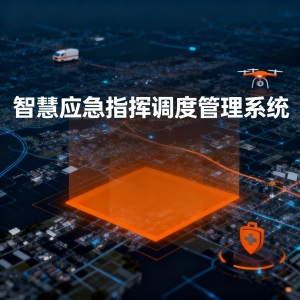
·Full-scenario integration:
Supports access to surveillance video, drone video, smart glasses video, VoLTE video, and eLTE broadband trunking, enabling consultation among on-site personnel, the command center, and expert meetings;
Supports IM messages, SMS, and other communication methods, broadening communication channels.
·Full-process command:
Pre-event — duty and on-call, emergency plan management, command drills;
During event — collaborative consultation, command and dispatch, unified wall display;
Post-event — summary and evaluation, comprehensive statistics display.
·Visualized dispatch:
Supports aggregated display and precise dispatch of personnel, equipment, and resources on a GIS map;
Supports on-site video backhaul and on-demand access to surveillance video;
Supports display of incident situation, unified display and control, and wall display.
Smart Emergency Command Center
Based on data standards, grounded in data governance, centered on data analysis, aimed at data services, and safeguarded by data security, it builds a big data center for smart emergency management.

Visualized Dispatch System
The visualized command and dispatch system integrates information resources based on an electronic map (PGIS). Through comprehensive integration of resources such as wireless digital trunking communication (PDT), wired communication, satellite communication, video surveillance, and checkpoint systems, it provides comprehensive information support, reliable communication assurance, and convenient dispatch applications for command and dispatch. It supports the establishment of a new command and dispatch system characterized by 'informatization-led, flat command, one-click dispatch, intelligent handling, and performance-based supervision,' comprehensively improving flat command, precise handling, and comprehensive combat capabilities.

Early Warning Perception System
It collects monitoring information and risk analysis information from local areas and relevant departments, searches, queries, or filters relevant information, and conducts risk assessment analysis as a basis for incident handling. When a public emergency occurs, it quickly and comprehensively obtains incident-related information, including multimedia data such as data, voice, and video, especially data around the incident site (such as temperature, humidity, gas concentration, rainfall, wind speed, wind direction, etc.) and video (such as live dynamic video or static images), and conducts risk assessment in combination with monitoring information and risk analysis information from local areas and relevant departments.

Early Warning Information Release System
Based on a cloud architecture, it builds a fully covered and fully connected four-level emergency warning information release system at the national, provincial, municipal, and county levels, enabling unified, precise, timely, and effective targeted release of various early warning information to decision-makers, emergency responsible persons, and the public. It practices the national new concept of disaster prevention and reduction, provides technical support for the government to improve emergency response capabilities and shift from traditional disaster relief to disaster prevention, enables the government to have unified, authoritative, timely, and effective early warning information release capabilities, and enhances government credibility.

Intelligent Auxiliary Decision-making System
After rescue personnel arrive at the scene and confirm the danger and related information, the system automatically generates emergency plans and rescue operation plans based on damage conditions, rescue personnel information, rescue vehicle information, material and equipment information, affected information, online monitoring information, video surveillance information, etc. Based on the condition of damaged pipeline network equipment, the system proposes requirements for personnel, materials, emergency equipment, etc. for pipeline network equipment repair.

Emergency Daily Management System
Emergency duty: mainly includes information reception and reporting, tracking and feedback, situation synthesis, and information notification during public emergency response; on-site audio and video image collection and access for public emergencies; government duty business management and comprehensive emergency business management; query and retrieval of emergency information and related data from various regions and relevant departments;
Emergency plan management: manage and maintain various emergency thematic data, including emergency resources, hazard sources, key protection targets, etc.;
Emergency training: conduct centralized training and remote online training for emergency rescue personnel in a planned manner to improve professional skills;
Public education: through communications, computer networks, radio, television, newspapers, and other means, publicize emergency laws and regulations and public prevention information such as risk avoidance, self-rescue, mutual rescue, and disaster reduction, enhancing the public's awareness of potential risks, social responsibility, and self-rescue and mutual rescue capabilities.
For specific product functions, please click Ant Smart Emergency Command and Dispatch Management System to learn more. Due to the specificity and scenario-based requirements of emergency systems, customization is usually required according to needs.