3.1. Product Architecture
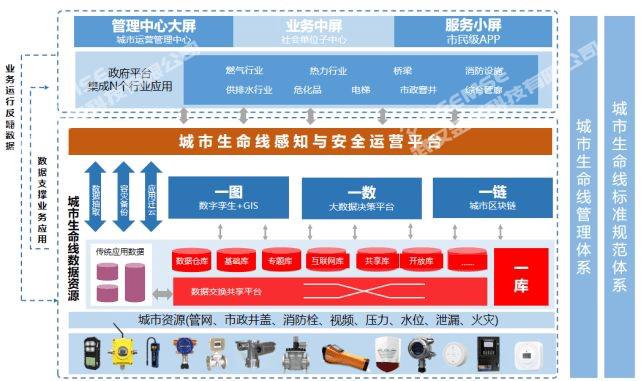
The urban lifeline product architecture includes the sensor layer, data acquisition and transmission layer, data storage and processing layer, application and service layer, security and communication layer, and intelligent decision-making and optimization layer. This architecture enables the urban lifeline monitoring system to collect, process, and analyze facility data in real time and provide related applications and decision support to ensure the safe operation of urban lifeline engineering.
1. Sensor layer: This layer is the foundation of the urban lifeline product architecture and includes various sensor devices, such as temperature sensors, pressure sensors, and flow sensors. These sensors are deployed on key urban facilities to monitor various parameters and status data in real time and transmit the data to upper-layer systems for processing.
2. Data acquisition and transmission layer: This layer is responsible for collecting data from the sensor layer and performing preprocessing and transmission. Data acquisition nodes connect to various sensors wirelessly or by wire, integrate and format the collected data, and then transmit it to upper-layer systems for analysis and processing. Common data acquisition and transmission technologies include Internet of Things technology and traditional communication networks.
3. Data storage and processing layer: This layer is the core of the urban lifeline product architecture and is mainly used to receive, store, and process large amounts of data from underlying sensors. This layer usually includes database systems, cloud services, and big data platforms. The data storage and processing layer can process, analyze, and mine data in real time or offline, generate useful information and indicators, and support decision-making and emergency response.
4. Application and service layer: This layer provides the user interface and functional modules of urban lifeline products and provides users with various applications and services. For example, it displays facility status, alarm information, and monitoring data through a visual interface; provides functions such as real-time early warning, fault diagnosis, and maintenance management; and supports data query, report generation, and statistical analysis. These applications and services can meet the needs of different users, including urban management departments, engineers and technical personnel, and residents.
5. Security and communication layer: This layer is mainly responsible for ensuring the security and stability of urban lifeline products. It covers security protection measures such as access control, identity authentication, and encrypted transmission. At the same time, this layer is also responsible for communication between the system and external systems or devices, ensuring the reliability of information transmission and interaction.
6. Intelligent decision-making and optimization layer: Based on technologies such as big data analysis, artificial intelligence, and machine learning, this layer conducts in-depth mining and analysis of collected data and provides intelligent decision support and optimization solutions. Through algorithms and models such as predictive analysis, fault diagnosis, and resource scheduling, it realizes optimized management and efficiency improvement of urban lifeline engineering.
3.2. Product Features
The Urban Lifeline Engineering Safe Operation Monitoring System has the following features:
1. Real-time capability: The monitoring system can collect and process facility data in real time and promptly reflect the status and changes of urban lifeline engineering. This enables the system to promptly identify problems, provide early warning and response, and thereby avoid or reduce possible accidents and losses.
2. Comprehensiveness: The monitoring system can monitor many different types of facilities and parameters, such as electricity, water supply, transportation, and communications, covering all key areas of the city. This enables the system to comprehensively monitor the entire urban lifeline engineering and provide overall safety assurance.
3. Diversity: The monitoring system can support many different types of sensor devices and monitoring technologies and adapt to the characteristics of different facilities and environments. This enables the system to flexibly respond to various monitoring needs and provide corresponding monitoring methods and algorithms for different types of facilities.
4. High reliability: The monitoring system uses highly reliable hardware devices and communication networks to ensure effective data collection and transmission. At the same time, the system also has automatic diagnosis and error correction functions, which can detect and repair possible faults and abnormalities and ensure stable system operation.
5. Scalability: The monitoring system can be expanded and upgraded as needed to adapt to the requirements of urban development and change. It can support access of new facilities, add new monitoring points, and introduce new technologies and algorithms to meet constantly changing monitoring needs.
6. Intelligence: The monitoring system can use technologies such as artificial intelligence and machine learning to analyze and mine data and provide intelligent decision support and optimization solutions. Through algorithms and models such as predictive analysis, fault diagnosis, and resource scheduling, the system can improve safety and efficiency and optimize resource utilization and operation management.
7. User-friendliness: The monitoring system has a good user interface and interaction functions so that users can conveniently use and operate the system. It provides intuitive data display, alarm notification, query and analysis functions, enabling users to obtain required information in a timely manner and make corresponding decisions and measures.
The Urban Lifeline Engineering Safe Operation Monitoring System has features such as real-time capability, comprehensiveness, diversity, high reliability, scalability, intelligence, and user-friendliness. It can comprehensively and effectively monitor and manage urban lifeline engineering and ensure the safe and stable operation of the city.
3.3. Core Product Functions
The system first conducts risk assessment of the urban lifeline system and, on this basis, scientifically optimizes the deployment of sensors. It conducts graded monitoring of bridges, pipe networks, underground spaces, and other facilities with different risk levels. Based on monitoring alarm information, the system conducts comprehensive analysis and judgment of urban lifeline risks, outputs risk location, level, and development trend through model algorithms, and releases risk and early warning information to relevant departments. It simultaneously analyzes and judges the development trend of warning events and generates auxiliary decision support plans such as emergency rescue team and resource allocation. The urban lifeline monitoring system mainly includes the following subsystems:
1. Smart Drainage Monitoring System
The Smart Drainage Monitoring System is based on dynamic monitoring of water levels, manhole cover movement, flow, and flow velocity at important nodes of the drainage network, as well as dynamic monitoring data of accumulated water levels in waterlogging-prone areas such as low-lying areas, tunnels, and culverts. It provides intelligent monitoring, analysis, and simulation prediction of urban drainage system operation, analyzes the degree of waterlogging disasters in real time, ensures timely alarms and efficient disposal when dangers occur, improves the operational efficiency of the urban drainage system, flood control and waterlogging drainage capacity, and the ability to determine illegal sewage discharge, and ensures the stable operation and smooth drainage of the drainage network.
2. Water Supply Network Monitoring System
Water supply network monitoring uses dynamic monitoring of pressure, manhole cover movement, and other conditions at important nodes of the water supply network to scientifically direct each water plant to start and stop water supply equipment, ensure balanced water supply pressure and stable flow, and avoid large-scale urban water outage accidents.
3. Gas Network Monitoring System
Gas network monitoring is based on dynamic monitoring of combustible gas concentrations in the gas network and adjacent underground spaces, providing timely prediction and early warning, eliminating hazard sources in the bud, thereby ensuring the safety of the gas network and its adjacent underground spaces, protecting people's lives and property, and maintaining social harmony and stability.
4. Heating Network Monitoring System
The Heating Network Monitoring System is based on pressure monitoring data and temperature conditions of the heating network from front-end network pressure monitors and real-time operating status monitoring information to discover heating network accidents, improve the reliability of heating network operation and the accuracy of maintenance, realize closed-loop management of network hazard investigation and elimination, improve the intelligent level of heating network supervision, early warning, and disposal, and enhance the flexibility of supervision methods.
5. Bridge Structure Monitoring System
The Bridge Structure Monitoring System is based on dynamic monitoring of displacement, settlement, tilt, vibration, acceleration, and other conditions of key structures such as main girders, main arches, piers, and expansion joints of bridges. It conducts smart health monitoring of bridges, collects and analyzes bridge data, realizes rating of bridge structure health operation status, and enables digital and intelligent bridge maintenance management, effectively reducing structural management and maintenance costs, improving structural durability, and extending bridge service life.
6. Building Structure Monitoring System
The Building Structure Monitoring System uses perception data from intelligent structural diagnostic instruments, environmental sensors, and video surveillance, and based on structural monitoring indicators such as horizontal displacement, settlement, tilt, vibration, and acceleration, as well as external conditions such as wind and temperature, realizes rapid assessment of building structural safety early warning and health. It effectively predicts the trend of building structural changes, allows managers to understand and inspect the operating status of buildings anytime and anywhere, strengthens building structural safety supervision, assists managers in scientific decision-making, reduces the occurrence of risk events, and protects people's lives and property.
7. Utility Tunnel Monitoring System
The Utility Tunnel Monitoring System mainly uses intelligent monitoring instruments to monitor in real time the surface structure settlement, displacement, and tilt of utility tunnels and combustible gas in adjacent underground spaces. It comprehensively perceives the safety of utility tunnel operation, realizes health digital model analysis, maintains the safety of utility tunnel structures, provides early warning for accidents affecting the normal operation of utility tunnels, implements advance control, realizes intelligent early warning for utility tunnel operation safety, promptly eliminates operational risks, and improves operational efficiency.